




Starting an online store is exciting—but choosing the right platform can be a bit tricky. If you’re in India and want to launch or grow your eCommerce business, two names you’re likely to hear a lot are Magento vs Shopify. Both platforms are powerful, popular, and trusted by thousands of businesses across the country and the world.
But here’s the real question: Which one is better Magento vs Shopify for your business?
At KGN Technologies, a trusted Magento development company in India and Shopify development company in India, we’ve helped businesses of all sizes pick the right platform based on their goals, budget, and technical needs. Some want full control and deep customization (hello, Magento!), while others want a fast, easy setup with built-in tools (Shopify fans, we see you!).
Whether you’re a small startup or a growing brand looking to scale, this guide will walk you through everything you need to know to make a smart choice. And don’t worry—we’ll keep things clear and simple so it’s easy to understand, even if you’re just getting started.
Let’s begin by understanding what these platforms are all about and how they work.
Understanding the Platforms: Magento vs Shopify
Before we compare the two, let’s understand what Magento vs Shopify actually are and what they offer.
What is Magento?
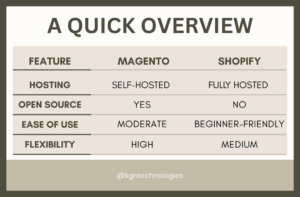
Magento is a powerful, open-source eCommerce platform trusted by large brands and businesses that need a highly customizable online store. It gives full control over how your website looks, works, and performs.
But here’s the catch: Magento needs technical skills. To set up, run, and grow a Magento store smoothly, you usually need help from a Magento development company or Magento ecommerce developers in India who know how to unlock Magento’s true potential to handle coding, extensions, and server setups.
Magento is best for:
- Businesses with unique design or functionality needs
- Stores with a large product catalog
- Teams who want full ownership and control
- Those working with a reliable Magento development company in India
What is Shopify?
Shopify is a cloud-based, all-in-one eCommerce platform that’s super beginner-friendly. You don’t need to be a developer to launch a store. Everything—hosting, security, updates—is handled by Shopify. That’s why it’s popular with small to mid-sized businesses who want to get up and running fast.
With the help of Shopify experts in India, you can design a professional-looking store, manage payments, and sell online without the headaches of technical stuff.
Shopify is best for:
- Small businesses and startups
- People who want a simple and fast setup
- Sellers with limited technical knowledge
- Brands working with a trusted Shopify development company in India
Both platforms offer strong eCommerce features—but the right choice depends on your goals, team, and growth plans.
Key Features Comparison: Magento vs Shopify
When choosing between Magento and Shopify for your eCommerce store, it’s important to know what each platform offers. Let’s look at how Magento vs Shopify features compare so you can decide which one fits your business better.
1. Ease of Use
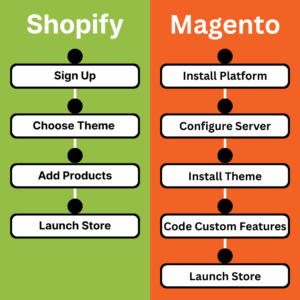
- Shopify is beginner-friendly. You don’t need to know coding. You can easily drag and drop to build your store.
- Magento, on the other hand, is powerful but more complex. It’s best suited for businesses that have a developer or work with a Magento development company.
2. Customization
- Magento offers complete control. You can build almost anything with the help of experienced Magento ecommerce developers in India.
- Shopify also allows customization, but it’s more structured. You can choose from many themes and apps — and if you work with Shopify experts in India, you can still create something unique.
3. Performance and Scalability
- Magento is known for handling large stores with lots of products. It’s highly scalable. You can learn more from “Magento performance optimization guide”
- Shopify is great for small to medium stores and can also grow with you, but there are limits unless you move to Shopify Plus.
4. SEO and Marketing Tools
- Both platforms are SEO-friendly. Magento gives you more freedom to control URLs, metadata, and more.
- Shopify makes it simple with built-in SEO features and apps that help improve rankings.
5. Payment Gateways and Checkout
- Shopify supports a wide range of payment gateways and has its own (Shopify Payments), which helps reduce transaction fees.
- Magento supports many gateways too, but it might need extra development to set up.
6. Security
- Security is crucial. Shopify handles hosting and security for you, just need to enable secure connections to your Shopify store.
- Magento is self-hosted (unless you use Adobe Commerce Cloud), so you’ll need to manage updates and patches — or get help from a Magento development company in India.
Cost Comparison: Which Platform Fits Your Budget?
Understanding the cost difference between Magento vs Shopify is important — not just the upfront price, but the ongoing costs too. Let’s break it down so you can see which one fits your budget better. 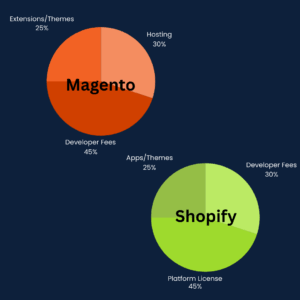
1. Initial Setup Costs
- Shopify offers monthly pricing plans starting from basic to advanced. It’s a plug-and-play solution, so you can start selling quickly without large setup fees. Working with a Shopify development company in India can help you customize your store affordably.
- Magento is open-source and free to download, but you’ll need to pay for hosting, security, and development. Many businesses hire a Magento development company in India to build and maintain their store.
2. Development & Customization Costs
- Shopify is simpler, so development time is shorter and costs are usually lower unless you need deep custom work with Shopify experts in India.
- Magento needs more development time due to its flexibility and complexity. If you want custom features, you’ll need skilled Magento ecommerce developers in India, which might mean higher development costs.
3. Hosting & Maintenance
- Shopify takes care of hosting, updates, and security in its monthly fees.
- Magento is self-hosted. You’ll need to choose a hosting provider and handle updates, which adds ongoing costs — unless you partner with a Magento development company to manage it.
4. Add-ons & Extensions
- Both platforms offer paid and free extensions. Shopify has an app store with subscription-based tools.
- Magento’s marketplace has powerful extensions too, but integration often requires a developer, adding to your cost.
5. Long-term Investment
- Shopify is a great budget-friendly choice for startups and growing businesses.
- Magento is better suited for larger businesses looking to scale with full control — even though it may cost more upfront, it can offer a bigger return if used well.
When to Choose Magento: Who is it Best For?
Magento is a robust, flexible platform designed for larger eCommerce businesses or those with unique needs. Here’s a breakdown of when you might choose Magento for your online store.
1. Custom Features & Flexibility
- Magento is known for its flexibility. If your store needs highly customized features or you have complex business requirements (e.g., custom product types, inventory management, or multi-store capabilities), Magento is the best choice.
- Working with a Magento development company in India will help you take advantage of its vast customization options to build a truly unique eCommerce experience.
2. Scalability
- Magento is built to handle large-scale stores. If you’re planning to grow your store exponentially, Magento is designed to support that. It can handle thousands of products, orders, and high traffic without compromising on performance.
- For businesses that expect significant growth, investing in Magento ecommerce developers in India will ensure your store can scale efficiently.
3. B2B E-Commerce
- Magento offers specialized features for B2B businesses, including customer-specific pricing, bulk ordering, and more.
- If you’re looking to create a B2B eCommerce site, Magento is one of the best platforms due to its ability to handle these complex requirements.
4. Complex Product Catalogs
- For stores with large inventories, complex product catalogs, or customizable products, Magento is the best option. It allows for multiple attributes, product variations, and detailed descriptions — perfect for businesses selling a wide range of products.
5. Full Control Over SEO & Analytics
- Magento gives you full control over your SEO strategies. You can optimize URLs, metadata, image alt tags, sitemaps, and much more using Magento SEO features.
- This makes Magento ideal for businesses that need complete control over their SEO strategy to drive organic traffic effectively.
6. Multi-language & Multi-currency Support
- If you plan to run a global eCommerce store, Magento’s built-in multi-language and multi-currency support makes it an ideal choice for international sales.
When to Choose Shopify: Who is it Best For?
Shopify is a user-friendly, scalable platform that works well for businesses of all sizes but is especially beneficial for small to medium-sized businesses that want to get up and running quickly. Here’s a breakdown of when Shopify might be the best option for your online store.
1. Ease of Use & Quick Setup
- Shopify is known for its ease of use. You don’t need to be a developer to set up and manage your store. This makes Shopify a great option for business owners who want a simple, hassle-free experience.
- With Shopify development services in India, you can quickly launch your store without spending too much time on technical setups.
2. Ideal for Small to Medium-Sized Businesses
- If you’re just starting or have a smaller inventory, Shopify is perfect. It’s easy to scale as your business grows, but without the complexity of Magento. For small business owners or those with a simpler catalog, Shopify experts in India can help you build a fully functional eCommerce store in no time.
3. App Integrations & Pre-Built Themes
- Shopify offers an extensive collection of pre-built themes and apps that allow you to add extra functionality to your store. This means you don’t need to hire developers for every little feature.
- Many businesses choose Shopify development company in India for cost-effective customizations that allow them to add advanced features to their stores without needing a lot of technical expertise.
4. Secure & Reliable Hosting
- Shopify offers built-in hosting with SSL certification, ensuring your store is secure and performs well. You don’t need to worry about finding a host or managing server configurations.
- This makes it ideal for users who prefer a fully managed, hassle-free experience.
5. Payment Gateway & Global Reach
- Shopify supports a variety of payment gateways, and its integrated checkout system is easy to use. Whether you’re selling locally or internationally, Shopify handles payments efficiently and securely.
- It’s also optimized for mobile commerce, meaning you can cater to customers shopping on smartphones and tablets, an increasingly important aspect of eCommerce.
6. Customer Support & Community
- With Shopify, you get 24/7 customer support as well as an active user community. Whether you need technical assistance or business advice, there are plenty of resources available.
Magento vs Shopify: Key Differences You Should Know
Now that we’ve explored the features and benefits of Magento and Shopify, it’s important to take a deeper look at the key differences that might influence your decision. Understanding these differences can help you choose the platform that aligns best with your business needs and growth goals.
1. Customization & Flexibility
- Magento is an open-source platform, meaning it provides immense flexibility and customization options. You can tailor the store exactly to your needs, build unique features, and integrate with virtually any third-party service. However, this level of customization often requires the expertise of Magento development company or skilled Magento ecommerce developers in India.
- Shopify, on the other hand, offers a more simplified, templated approach to building your store. While it provides many customization options through apps and themes, it’s not as flexible as Magento. You’ll be limited to what Shopify allows unless you dive into code, which still requires technical knowledge.
2. Cost of Development
- Magento development typically involves higher upfront costs because it requires more technical resources. You might need to hire a Magento development company in India or a specialized team of developers. Additionally, the cost of hosting and maintenance may be higher due to the self-hosted nature of Magento.
- Shopify is subscription-based with clear pricing tiers. The cost to build a Shopify store is generally more affordable and predictable. However, the cost of apps, themes, and custom development might add up over time. Despite this, Shopify development services in India are often more affordable than Magento development in terms of initial setup.
3. Scalability
- Magento shines when it comes to scalability. It can handle large catalogs and high volumes of traffic with ease. Businesses with complex needs, like custom product options, large inventories, and heavy traffic, benefit from Magento’s ability to scale as they grow.
- Shopify is scalable but typically better suited for small to medium-sized businesses. While Shopify can handle growing businesses, very large enterprises with complex needs may encounter limitations. Shopify experts can help you scale your ecommerce business, but it still won’t offer the level of flexibility that Magento provides.
4. Technical Skills Required
- With Magento, you’ll need a good amount of technical expertise. Managing the platform, customizing it, and troubleshooting require a solid understanding of coding. This is why hiring a Magento development company in India is often the best option for businesses looking for a high degree of customization.
- Shopify is a more user-friendly option for those with little technical knowledge. It allows you to manage your store with ease, even if you don’t have coding experience. It’s ideal for business owners who want a straightforward, easy-to-use platform. However, if you want custom features or advanced functionality, you’ll need the help of Shopify development company in India.
5. SEO & Marketing Capabilities
- Both Magento and Shopify offer good SEO capabilities, but Magento provides greater flexibility when it comes to optimization. You can optimize each page, URL structure, metadata, and content according to your exact needs, which can be a huge advantage in the highly competitive world of eCommerce.
- Shopify also supports SEO practices but with a more streamlined approach. It’s easier to set up, but you may be limited when it comes to advanced SEO techniques. For business owners looking for simplified, out-of-the-box SEO, Shopify development services in India can handle the basics without the complexity.
6. Security Features
- Magento offers a robust security system but requires the user to implement additional security measures, such as SSL certificates and secure payment gateways. Being an open-source platform, the responsibility for security lies largely with the site owner.
- Shopify provides an integrated, hosted environment that includes built-in security features like SSL certification and secure checkout. With Shopify, security is handled for you, so there’s less work on your end to ensure data protection.
Which Platform is Best for Your Business: Magento vs Shopify?
At this point, we’ve discussed the core differences between Magento vs Shopify, so now let’s focus on which platform is truly the best choice for your specific business needs. The right choice depends on factors like your business size, budget, technical expertise, and long-term goals.
1. If You’re a Small to Medium-Sized Business
- Shopify is likely your best bet. It’s user-friendly, cost-effective, and offers a variety of themes and plugins that allow you to set up a professional store quickly without much technical knowledge. You can get started with Shopify even if you’re on a tight budget, and its subscription-based pricing makes it easy to forecast costs.
- Shopify development services in India are a great option if you need customization without the hefty price tag of Magento.
2. If You Have a Large Business or Enterprise Needs
- Magento excels for large businesses or enterprises that require a highly customizable and scalable platform. If you have a vast product catalog, complex business processes, or the need for custom features, Magento’s flexibility and ability to handle high traffic make it the better choice.
- Choosing a Magento development company in India with experience in enterprise-level eCommerce can help you take full advantage of Magento’s features and create a site that can grow with your business.
3. If You Have Limited Technical Resources
- Shopify is designed for ease of use. You don’t need to be a developer to manage your store effectively. If you prefer a simple setup with less hassle, Shopify’s user-friendly interface and built-in features make it ideal.
- For those with limited technical resources but still requiring customization, Shopify experts in India can help you tweak your store, manage apps, and optimize the platform without needing a full-time developer.
4. If You Prioritize Full Customization
- If you need full control over your store’s design and functionality, Magento offers unmatched flexibility. Its open-source nature means you can create a completely unique eCommerce experience for your customers. However, it does require a certain level of technical expertise.
- Businesses that require high levels of customization should partner with an experienced Magento ecommerce developer in India to ensure smooth implementation.
5. If You Need a Quick Setup
- If you’re looking to launch your online store quickly, Shopify is the way to go. It provides a quick setup with a vast array of pre-designed templates. You can launch your store in just a few days, and its easy-to-use interface allows you to focus more on selling than managing the technical side of things.
6. If Your Budget is Tight
- Shopify generally has a lower upfront cost, especially when compared to Magento, which may require higher initial development costs due to its complexity. While both platforms have ongoing costs, Shopify’s predictable pricing model makes it more budget-friendly for smaller businesses.
- Magento may seem more appealing to those with big budgets, but be prepared for the ongoing investment in development, hosting, and security.
Conclusion: Which Platform Will Help Your Business Thrive?
Both Magento and Shopify are powerful eCommerce platforms, but the right one depends entirely on your business goals, team capabilities, and customer expectations.
If you’re looking for simplicity, faster launch time, and cost-effectiveness, Shopify is your go-to. It’s ideal for startups, small businesses, or anyone without technical expertise who wants to manage their store easily. With the support of a trusted Shopify development company in India or Shopify experts India, even basic setups can be transformed into professional, high-converting stores.
On the other hand, if your business needs scalability, flexibility, and complete control, Magento is a better fit. It’s perfect for businesses with larger catalogs or more complex eCommerce requirements. Partnering with a seasoned Magento development company in India or a team of skilled Magento ecommerce developers India ensures you can unlock the full power of Magento while staying technically sound.
Final Thought:
There is no one-size-fits-all answer. It all comes down to choosing a platform that aligns with where your business is today — and where you want it to go tomorrow. Whether it’s Shopify or Magento, your success will depend not just on the tool you use, but on how well you use it with the right development partner.
Still confused between Magento vs Shopify? Contact our team at KGN Technologies — your trusted Magento and Shopify development company in India.